In Boggle, a word counts if it’s a real word, meets the minimum length, and can be traced through letters that touch each other on the board. That simple rule covers most situations, but questions still come up during scoring: are plurals allowed? What about names, abbreviations, slang or very short words?
This guide explains which words are normally accepted, which are not, how to choose a dictionary and how to settle a disputed word quickly, so the game can carry on without an argument.
The Basic Rules for Valid Boggle Words
A word generally needs to meet three conditions to count: it must be accepted by the chosen word list, meet the minimum length, and be traceable through adjacent letters on the board.
1. The word must be accepted by a dictionary
A valid word must appear in the dictionary or word list used for your game. Made-up words and misspellings do not count, even if they sound convincing or resemble familiar words.
Some dictionaries include regional expressions, older terms, and uncommon vocabulary that other references may leave out. This is why agreeing on a dictionary before a competitive game can prevent disagreements.
2. The word must meet the minimum length
In standard Classic Boggle, a word needs at least three letters. Big Boggle generally requires at least four letters because it uses a larger 5×5 grid.
The Qu tile represents two letters, Q and U, even though they occupy a single tile. For example, QUA has three letters, so it meets the usual minimum for Classic Boggle, provided the letters can be traced on the board.
3. The letters must connect on the board
Each letter must touch the next horizontally, vertically, or diagonally. You cannot use the same tile more than once in a single word.
For example, LOOP requires two separate O tiles. If the board does not provide a valid path through L, O, O, and P using distinct tiles, the word cannot count, even though LOOP is a real English word.
Words That Are Usually Allowed in Boggle
Many familiar word forms count as long as they appear in the accepted dictionary and can be formed on the board.
Common nouns, verbs, and adjectives
Everyday words such as STONE, RUN, QUIET, and SOON can count when they meet the game's requirements. The word's grammatical category does not determine its score; its validity and length do.
Plurals
Plural forms are generally allowed when they appear in the chosen word list. For example, CAT and CATS can both count if each can be traced separately and meets the minimum word length.
Irregular plurals, such as MICE and GEESE, can also qualify when the dictionary recognizes them and the board supports their letter paths.
Verb forms and comparisons
Different forms of a word may count separately. PLAY, PLAYS, PLAYED, and PLAYING are examples, provided each form is accepted and can be traced on the grid.
Comparative and superlative forms, such as FAST, FASTER, and FASTEST, may also count when they meet the same requirements.
Shorter words inside longer words
A longer word does not prevent you from scoring a shorter word that uses some of the same letters. For example, STONE and TONE may both count if each has its own valid path and meets the minimum length.
You must trace every word independently. A shorter word does not automatically count just because its letters appear in a longer word.
Words That Are Usually Not Allowed
On the other side, a few categories are normally excluded. Agreeing on these before you start saves a lot of debate during scoring.
| Type of word | Example | Why it doesn’t count |
|---|---|---|
| Proper nouns | LONDON, SARAH | Names of people and places aren’t general words |
| Abbreviations | TV, USA, ETC | They’re shortened forms, not full words |
| Hyphenated words | X-RAY | Hyphens can’t be formed on the board |
| Words with apostrophes | DON’T, IT’S | Apostrophes aren’t on the dice |
| Words that are too short | AN, TO | They don’t meet the minimum length |
| Words needing a die twice | LOOP with one O | Each die can only be used once per word |
Names that are also ordinary words
Some words are both a name and an everyday word, such as MARK, ROSE or BILL. These are usually accepted when they have a normal meaning, because they appear in standard dictionaries as ordinary words.
Slang and very new words
Slang and recently coined words are the trickiest category. Whether they count depends on your dictionary. If a word isn’t in the reference you’ve agreed to use, it’s safest to leave it out.
Which Dictionary Should You Use?
The rules say a word must be “real”, but dictionaries disagree about rare, regional and slang words. The fairest approach is to choose one reference before the game and stick to it for every round.
For casual games, many families use any standard dictionary and accept words most players recognise. For more competitive play, a fixed word list is better, because it removes judgement calls entirely and treats every player the same.
Online games make this decision for you. Our game checks each word against a large English word list of more than 270,000 entries. That’s why it sometimes accepts unusual words that a casual player might not know, while still rejecting names and abbreviations.
How to Settle a Disputed Word
Most disputes aren’t really about whether a word exists, but whether it can actually be traced on the board. A simple routine settles them quickly and fairly.
- Check the path first. Ask the player to point to each letter in order and confirm that every step moves to a touching die.
- Check for repeated dice. Make sure no single die is used twice in the word.
- Check the dictionary. Only if the path is valid, look the word up in your agreed reference.
If you’re playing with a physical board and want a definite answer, you can check possible words with the Boggle Solver. Enter the letters in their positions, and it lists every valid word along with the path for each one.
How Valid Words Affect Your Score
Once a word is accepted, its points depend on its length, not on how unusual it is. A rare five-letter word scores exactly the same as a common one, so there’s no bonus for obscure vocabulary.
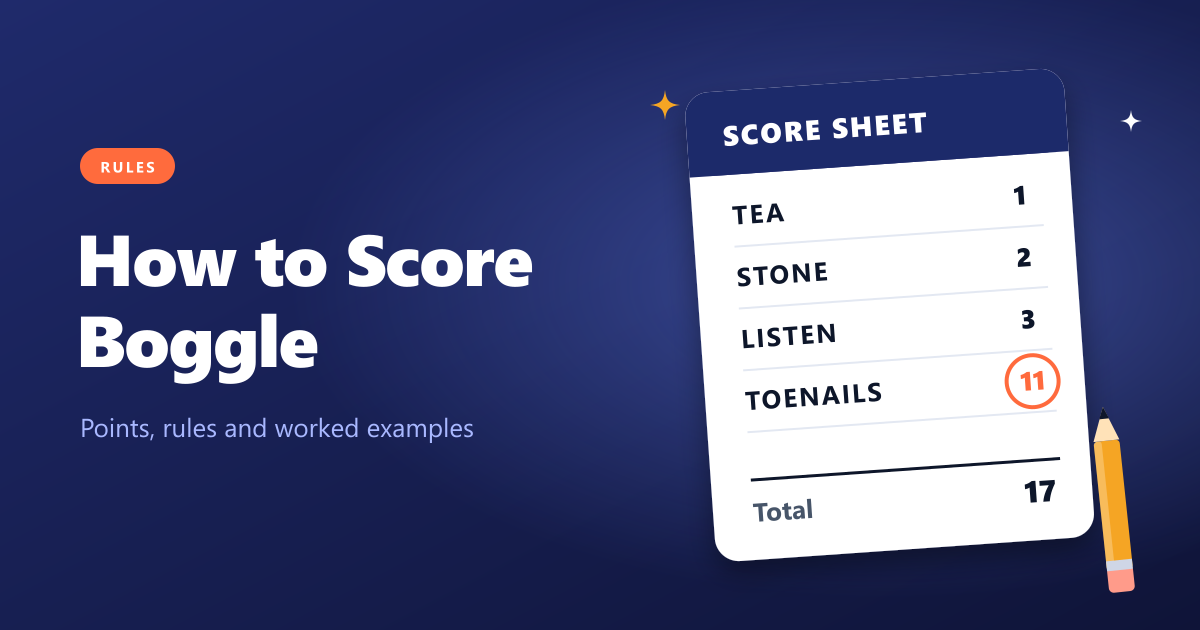
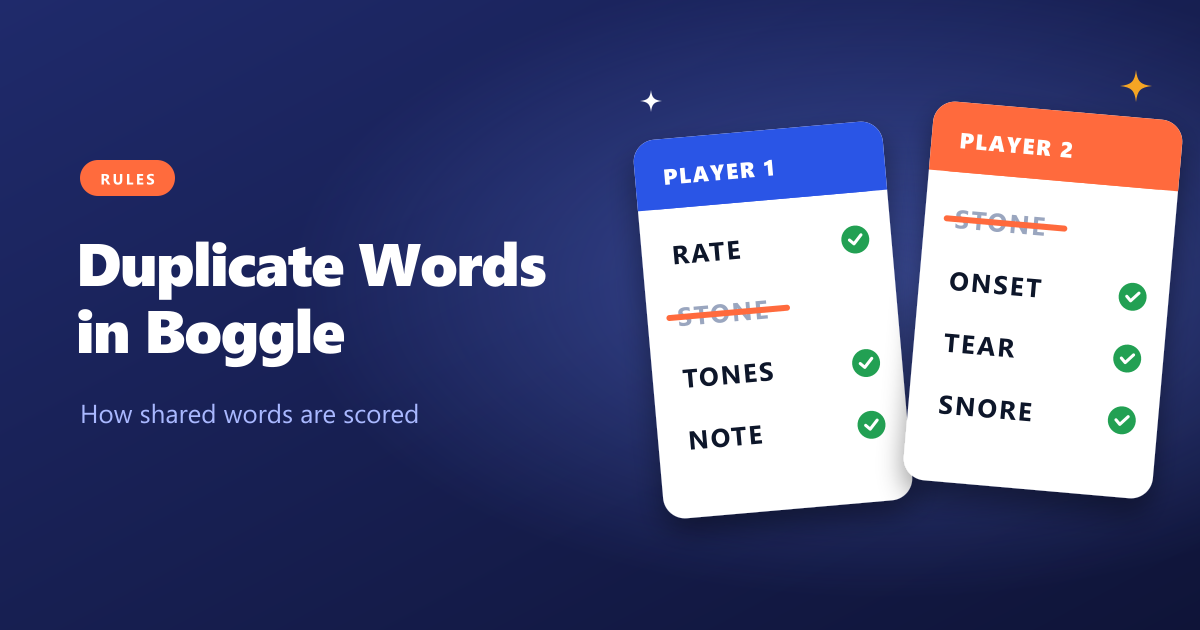
In multiplayer games, valid words can still end up scoring nothing if another player found them too. Our guide on how to score Boggle explains the full points table and how shared words are handled.
Put Your Knowledge to the Test
The best way to get a feel for which words count is to play a few rounds and see what’s accepted. When you play Boggle online on our site, each word is checked as soon as you enter it. A short message explains why a word didn’t count, whether it was too short, already found, not connected or not in the word list.
At the end of each round, you’ll also see every valid word on the board, including the ones you missed. Browsing that list is a quick way to learn which kinds of words are accepted.
Final Thoughts
A Boggle word is valid when it’s real, long enough and traceable through touching letters. Plurals, verb forms and words inside other words usually count, while names, abbreviations, hyphenated words and contractions usually don’t.
Agree on a dictionary before you play, check the path before debating a word, and most disputes will disappear before they start.