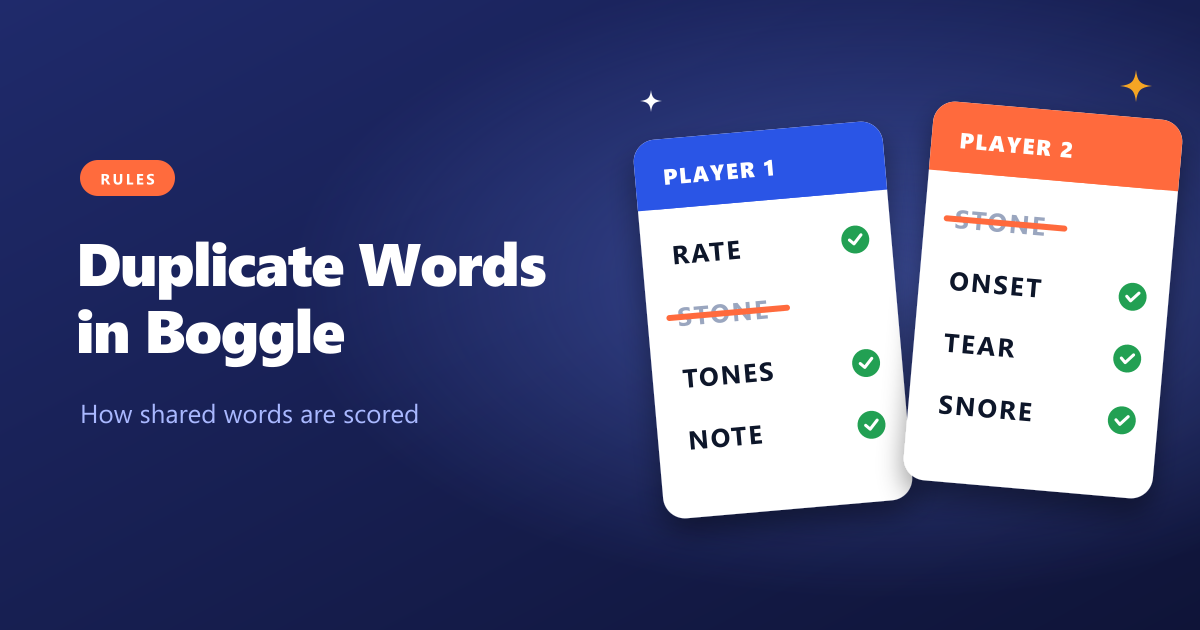
In a multiplayer game of Boggle, a word that two or more players have found is crossed out on every list, and no one scores it. It’s one of the most important rules in the game, and also one of the most surprising for new players, who often expect every valid word to count.
This guide explains what counts as a duplicate, how the rule works during scoring, why it exists and how it shapes strategy. It also covers popular house rules for softening it, which can be useful for beginners and children.
What Counts as a Duplicate Word?
A duplicate is simply the same word appearing on more than one player’s list. The details matter, though, because they decide which words get crossed out and which survive.
The spelling decides
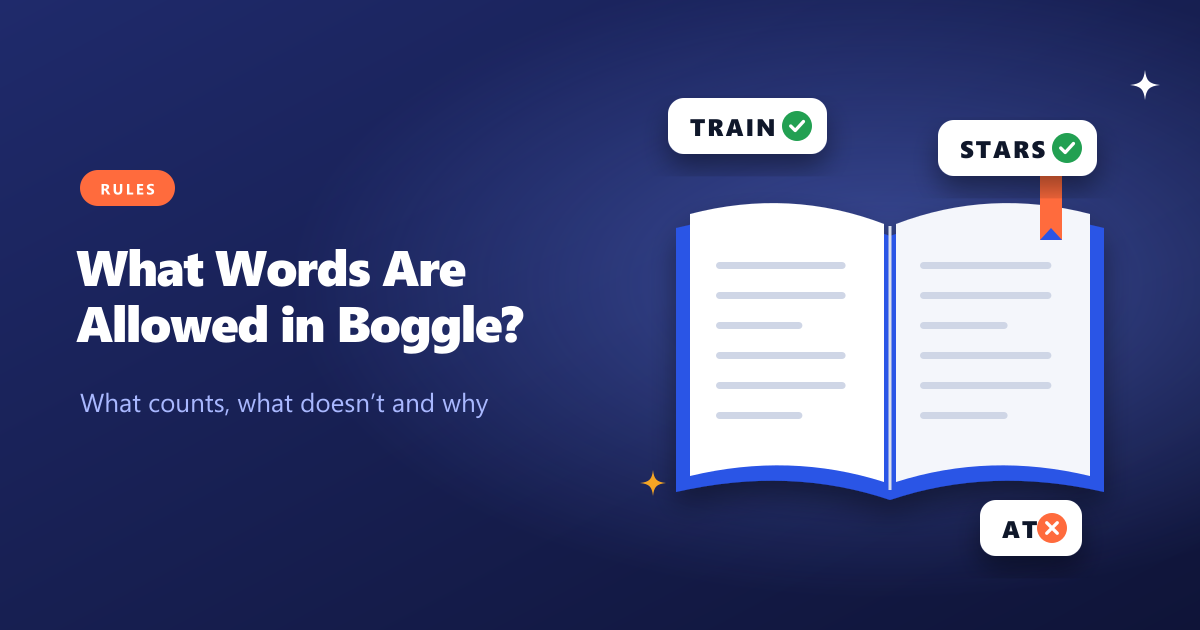
If two players wrote STONE, it’s a duplicate, even if they traced it through different letters on the board. Boggle only cares about the word itself, not the path used to make it.
Different forms are different words
CAT and CATS are not duplicates of each other, and neither are PLAY and PLAYED. If one player wrote CAT and another wrote CATS, both words survive and both players score.
This is why adding plurals and endings is such a useful habit. Opponents often stop at the base word, leaving the extended version for you.
Only shared copies are removed
If three people are playing and only two of them found a word, it’s crossed out for those two players. The third player never had it, so nothing changes on their list.
The Traditional Rule in the Boggle Board Game
Duplicates are handled at the end of each round, before anyone adds up points. In the classic Boggle board game, the process usually goes like this:
- When the timer runs out, all players stop writing.
- One player reads their list aloud, word by word.
- Anyone else who has the same word says so, and every copy of that word is crossed out.
- The next player reads the words remaining on their list, and the process repeats.
- Once every list has been read, players score only the words left standing.
Reading lists in turn keeps things organised, especially in larger groups where some words appear on three or four lists. It also gives everyone a chance to check disputed words before the scores are added up.
Tips for checking lists quickly
With several players, comparing lists can take longer than the round itself. A few small habits speed things up:
- Write words in a single clear column so they’re easy to scan.
- Read each word clearly and pause briefly so others can check their lists.
- Cross out shared words straight away rather than at the end.
Why the Duplicate Rule Exists
At first, crossing out perfectly good words can feel harsh. In practice, it’s what makes multiplayer Boggle interesting and competitive.
Without the rule, every player would collect the same obvious words, and scores would end up very close. With it, easy words often cancel out, so the winner is usually the player who spotted something different.
The rule also balances games between players of different levels. Simply writing quickly isn’t enough; you need to find words that others miss, which rewards careful searching and a wide vocabulary.
How Duplicates Affect Your Score
Because shared words score nothing, the final result can look very different from the length of each list. Here’s a simple example with three players:
| Word | Player A | Player B | Player C |
|---|---|---|---|
| TEA | Crossed out | Crossed out | Crossed out |
| RATE | Crossed out | Crossed out | — |
| STONE | 2 | — | — |
| TOAST | — | — | 2 |
| SEAT | — | 1 | — |
| Total | 2 points | 1 point | 2 points |
Player B found three words but scored only one point, because two of them were shared. Player A and Player C scored more by each finding one five-letter word nobody else spotted.
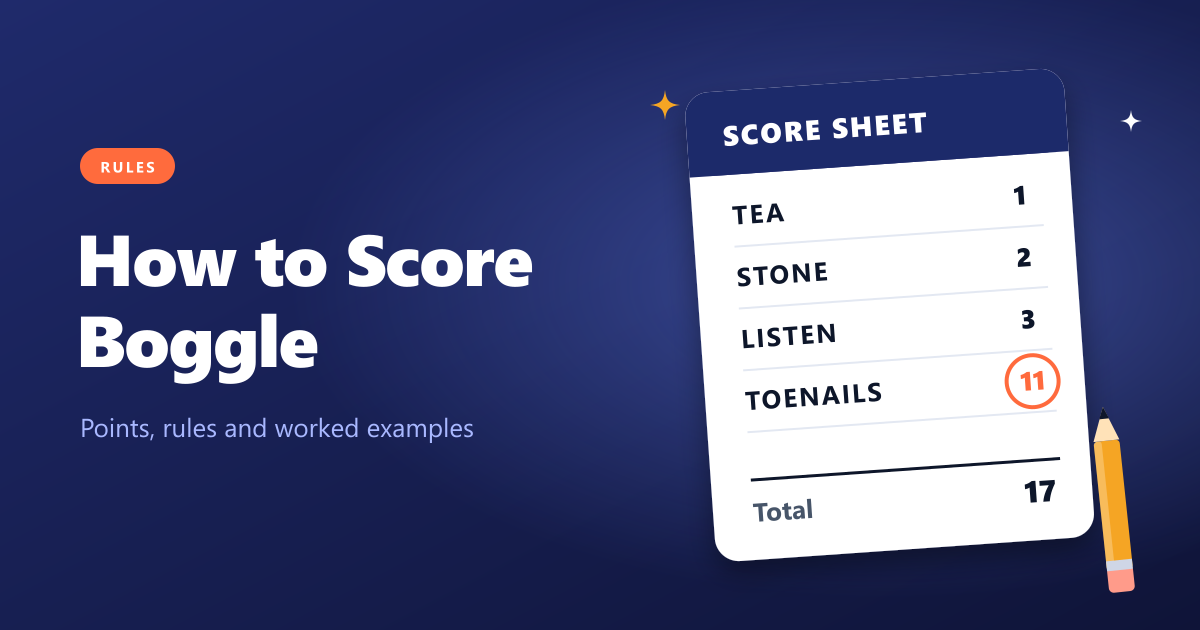
For a full explanation of points by word length, see our guide on how to score Boggle.
What If You Write the Same Word Twice?
Repeating a word on your own list doesn’t earn extra points. Each word counts only once per player, no matter how many times it appears or how many different paths it can take on the board.
Online games handle this automatically. In our single-player game, entering a word you’ve already found shows an “Already found” message, and your score stays the same.
House-Rule Variations
The traditional rule works well for competitive players, but it isn’t the only option. Many groups adjust it to suit their table, especially when players have very different levels of experience.
Keep all words
Everyone scores every valid word, shared or not. This is the friendliest version and works well for beginners, because nobody loses points for finding an obvious word.
Half points for shared words
Duplicates still score, but at a reduced value. It keeps some of the competitive edge while softening the disappointment of losing a word.
Protect long words
Only short duplicate words are crossed out, so long finds are never lost. This encourages players to search for bigger words without the risk of losing them.
Softer rules are especially helpful with younger players, who can feel discouraged when their words disappear. Our guide on playing Boggle with kids includes more ideas for family and classroom games.
Strategy: Find Words Others Will Miss
Since common words often cancel out, the best multiplayer strategy is to look where others aren’t looking. A few habits make a real difference:
- Search for longer words. They’re worth more and are far less likely to be shared.
- Explore quieter corners. After collecting a few easy words, look at the parts of the board others may be ignoring.
- Add plurals and endings. Players often stop at the base word, so the extended forms are more likely to survive.
- Use less common letters. Words built around letters such as K, W or Y are less likely to appear on other lists.
Final Thoughts
The duplicate rule is simple: if more than one player found a word, nobody scores it. It rewards original thinking, keeps multiplayer games competitive and makes long, unusual words especially valuable.
Use the traditional version for serious play, or soften it for beginners and children, as long as everyone agrees before the timer starts.