Boggle scoring is simple once you’ve seen it: every valid word earns points based on how many letters it has, and longer words are worth much more. A three-letter word earns a single point, while a word of eight letters or more earns 11.
Most of the confusion comes from the edge cases. What happens when two players find the same word? How many letters does the Qu tile count as? Do plurals score separately? This guide explains the standard points table, walks through scoring a round step by step, and answers the questions that new players ask most often.
The Standard Boggle Scoring Table
Points in Boggle depend only on word length. It doesn’t matter which letters you use, how rare they are or where they sit on the board. A common word and an unusual word of the same length score exactly the same.
Here is the points table used in a standard game:
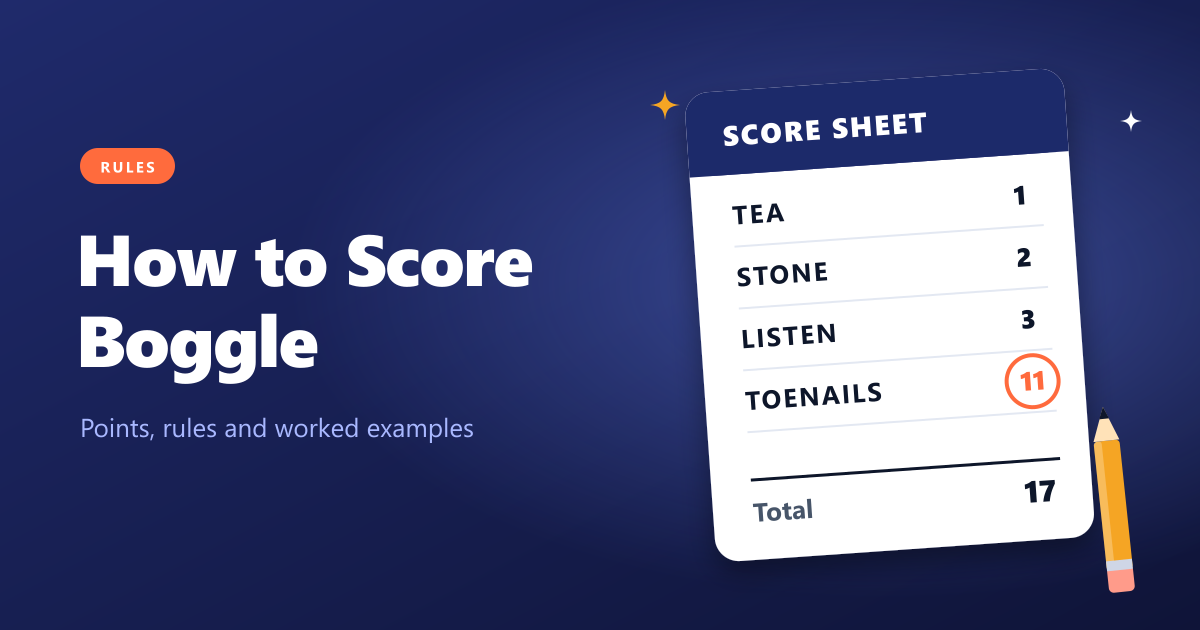
| Word length | Points | Example |
|---|---|---|
| 3 letters | 1 | TEA |
| 4 letters | 1 | TEAS |
| 5 letters | 2 | STONE |
| 6 letters | 3 | STOLEN |
| 7 letters | 5 | LISTENS |
| 8 letters or more | 11 | TOENAILS |
Why the points rise so steeply
Notice how slowly the points grow at first and how sharply they jump at the top. Three- and four-letter words score the same single point, while going from seven letters to eight more than doubles the reward.
This is deliberate. Short words are easy to find, and almost every player will have plenty of them. Long words take real skill to spot, so the table rewards them heavily. In practice, a single eight-letter word earns as much as eleven three-letter words, which is why long words often decide close games.
What the table means for your strategy
Understanding the table changes how you spend a round. Short words are still worth collecting, especially early on, but the biggest gains come from words of five letters or more.
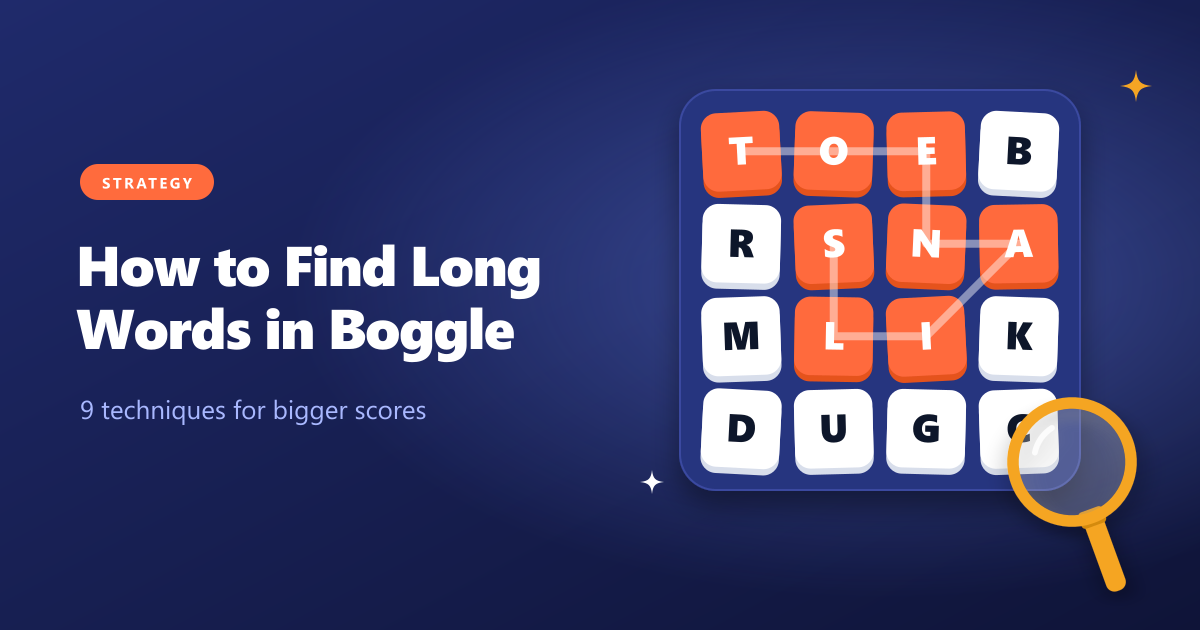
A sensible approach is to gather quick short words first, then spend the rest of the round looking for longer words and extensions such as plurals and verb endings.
How to Score a Round, Step by Step
At the table, scoring happens after the timer runs out. A clear routine keeps it quick, fair and friendly, whether you have two players or six. Here’s the process most groups follow.
Step 1: Stop writing when the timer ends
As soon as the timer runs out, everyone puts their pens down. Any word written after time is up doesn’t count, and a word that was only half finished doesn’t count either. Agreeing on this before the game prevents arguments later.
Step 2: Read the lists aloud
Players take turns reading their words while everyone else checks their own list. Reading one word at a time, clearly, makes it easy for others to spot matches.
Step 3: Cross out shared words
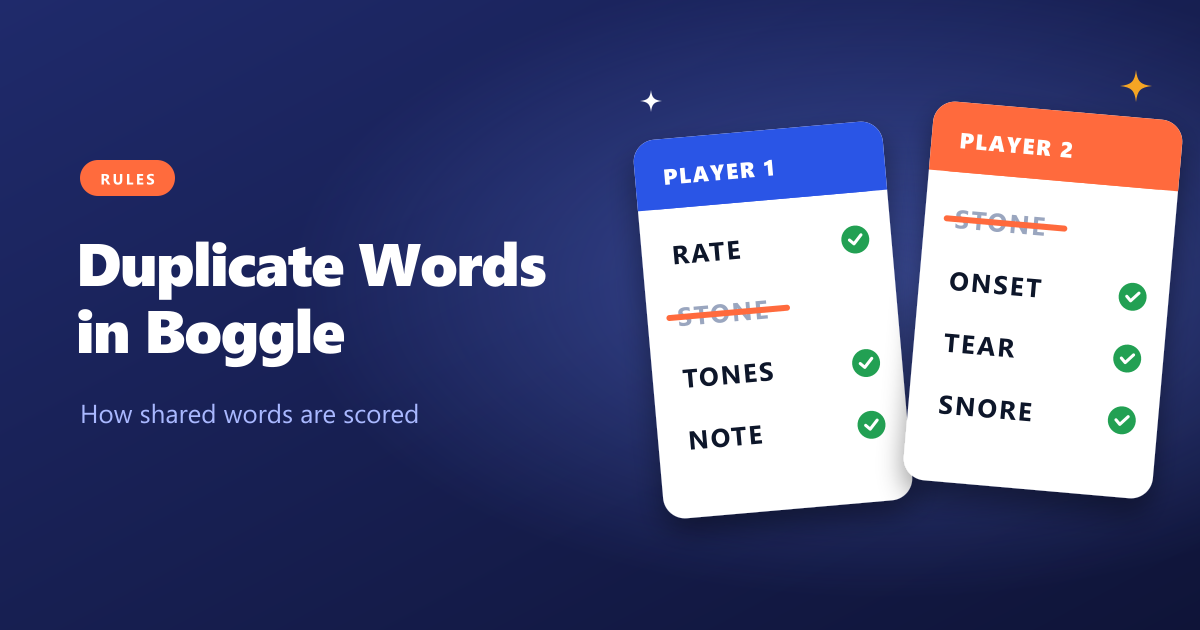
In the traditional rules, any word that appears on more than one player’s list is crossed out on every list, and no one scores it. This step usually removes several common short words.
Step 4: Check disputed words
If someone questions a word, confirm two things: that it’s a real word, and that it can be traced through touching letters without using any die twice. If either check fails, the word is removed.
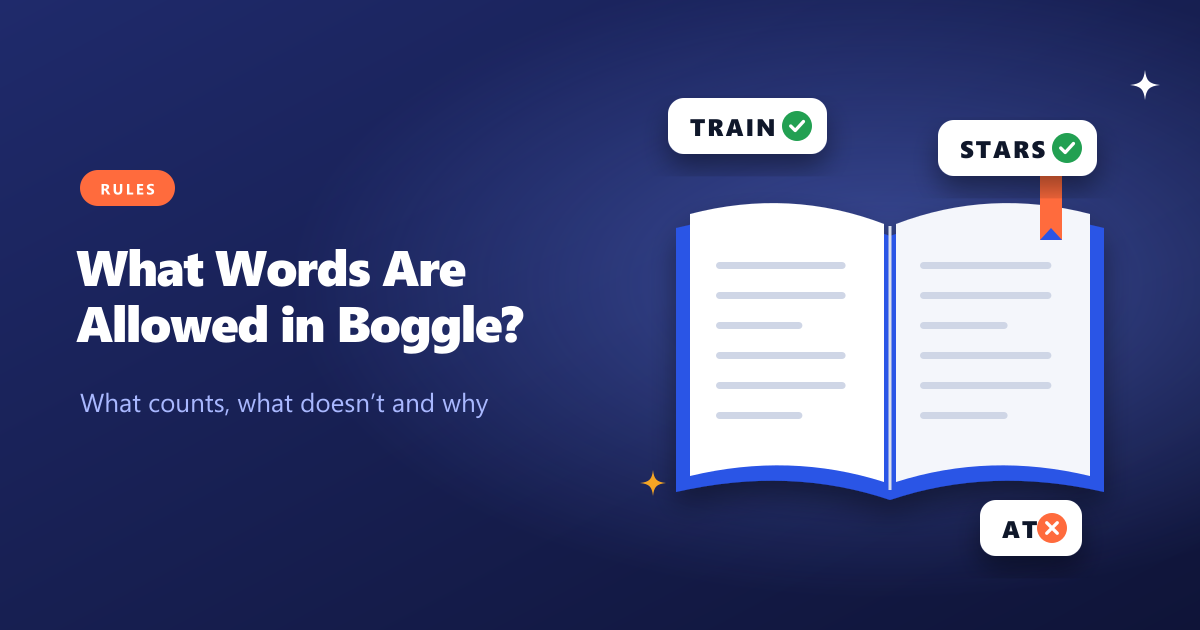
If you’re unsure which words should stand, our guide to which words are allowed in Boggle explains what normally counts, from plurals and verb forms to proper nouns and abbreviations.
Step 5: Add up the points
Score each remaining word using the table above and total the results. Many groups play several rounds and keep a running total, with the first player to reach an agreed score, such as 50 or 100 points, winning the game.
A Worked Scoring Example
Seeing a real tally makes the rules click. Imagine two players finish a round with these words:
| Word | Player A | Player B |
|---|---|---|
| RATE | Crossed out | Crossed out |
| TEAR | 1 | — |
| STONE | — | 2 |
| TRAINS | 3 | — |
| STAINER | 5 | — |
| Total | 9 points | 2 points |
Both players found RATE, so it earns nothing for either of them. Player B also found STONE, which scores 2 points. Player A wins comfortably, mostly thanks to two longer words, TRAINS and STAINER, which together earn 8 points.
The lesson is clear: Player B didn’t lose because they found fewer words, but because Player A found longer ones that nobody else spotted.
Special Scoring Cases
A few situations come up often enough that it’s worth agreeing on them before you start. Here’s how each one works under standard rules, with examples.
Duplicate words
Shared words are the biggest difference between casual and traditional scoring. In a standard game, a word that two or more players found is crossed out for everyone. Repeating a word on your own list doesn’t earn extra points either; each word counts once.
Our article on duplicate words in Boggle explains the rule in detail, including what counts as a duplicate and popular house rules for softening it.
The Qu tile
One die shows “Qu” on a single face. When you count letters, it counts as two.
QUIT uses only three dice but is a four-letter word, so it scores 1 point. QUEST is five letters and scores 2, while QUARTER is seven letters and scores 5.
Plurals and verb forms
Different forms of a word are separate words. If you find PLAY, PLAYS and PLAYED, each one scores on its own. The same is true for comparisons such as FAST, FASTER and FASTEST.
Finding an S next to the end of a word is one of the easiest ways to pick up extra points.
Words inside other words
Shorter words hidden inside longer ones still count, as long as each can be traced on its own. If you find STONE, you may also be able to score TONE and ONE, provided they meet the minimum length.
Big Boggle boards
On a 5×5 board, words usually need at least four letters, so three-letter words don’t score. The rest of the points table stays the same, which makes long words even more important on the bigger board.
Practise Scoring With Real Rounds
The fastest way to get comfortable with scoring is to play a few rounds and watch the points add up. When you play Boggle free online on our site, every word is checked and scored the moment you enter it, so you can focus on finding words instead of doing sums.
After each round, the review screen lists every word on the board, grouped by length. It’s an easy way to see how many points were available and which longer words you could have scored.
Tips for Scoring More Points in Boggle
Understanding the table also tells you where the points really are. Keep these ideas in mind during your next round:
- Look for longer words: Five-letter words and longer earn more points than three- and four-letter words.
- Check common endings: Look for valid plurals and verb forms when the board contains the necessary letters.
- Explore different directions: Scan horizontally, vertically, and diagonally to avoid missing possible word paths.
- Use the Qu tile carefully: Remember that Qu counts as two letters for scoring purposes, even though it occupies one tile.
- Review missed words: After a round, check which words you overlooked and look for patterns that could help next time.
Final Thoughts
Boggle scoring comes down to one idea: longer words earn more. Learn the six rows of the points table, agree on how to handle shared words, the Qu tile and disputed words, and scoring becomes a quick and friendly part of every round.
Once the rules feel familiar, use them to your advantage by aiming for longer words and less obvious finds.