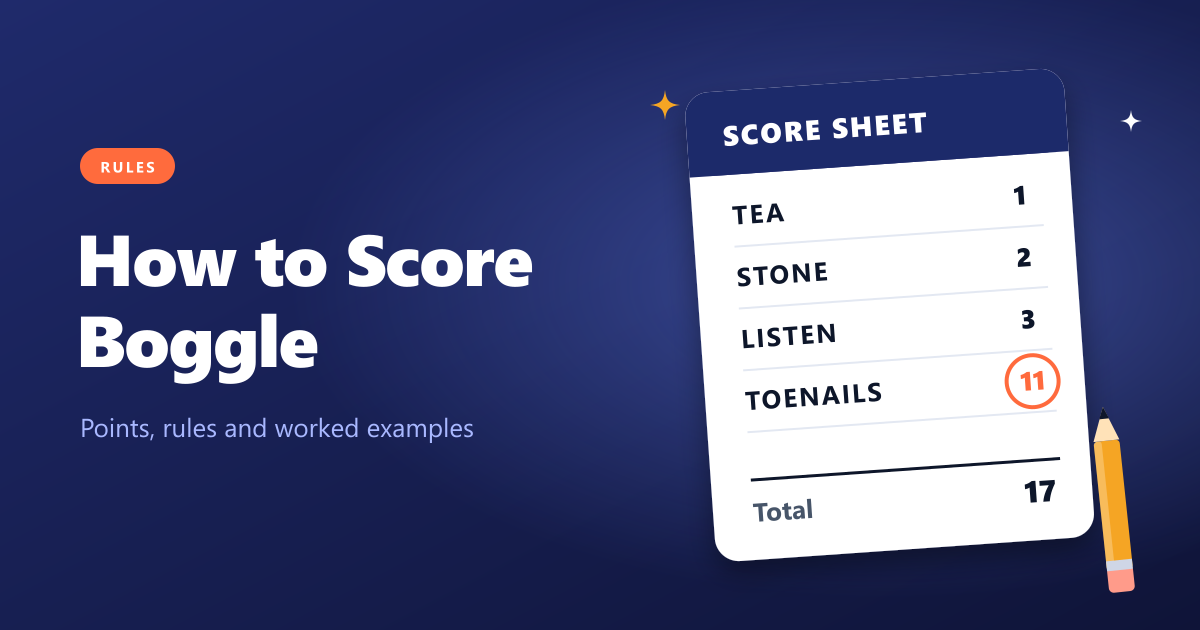
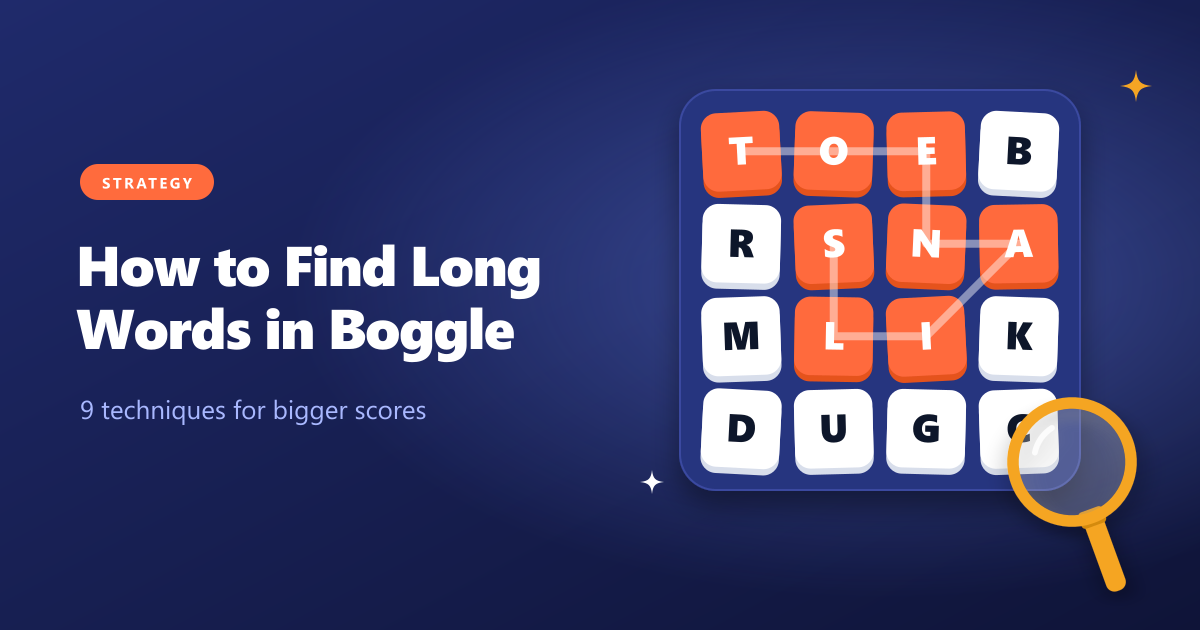
Long words are where the big points are in Boggle. Under standard scoring, a seven-letter word earns 5 points and an eight-letter word earns 11, compared with just 1 point for a three-letter word. Yet many players rarely find anything longer than five letters.
The problem usually isn’t vocabulary. Long words are simply hard to spot if you search letter by letter. This guide shares nine techniques for building longer words from the patterns already on the board, along with a practice routine to make them stick.
Why Long Words Matter So Much
Boggle scoring rises steeply with length, so a single long word can change the result of a round. This table shows how quickly the value grows compared with short words:
| Word length | Points | Equal to |
|---|---|---|
| 5 letters | 2 | Two short words |
| 6 letters | 3 | Three short words |
| 7 letters | 5 | Five short words |
| 8 letters or more | 11 | Eleven short words |
In multiplayer games, long words have a second advantage: other players are less likely to find them, so they’re less likely to be crossed out as duplicates. A long word is often both worth more and safer.
9 Techniques for Finding Long Words
Each technique below helps you see a longer word as a set of familiar pieces rather than a random string of letters. Try one or two at a time until they become automatic, then add the others.
1. Start from the ending
Endings such as -ING, -ED, -ER, -ERS, -EST and -LY are the backbone of many long words. They’re also easy to spot, because the letters sit together on the board.
Find an ending first, then trace backwards to see which letters lead into it. An -ING ending connected to a few useful consonants and a vowel often hides a six- or seven-letter word, such as RAISING or TRAINING, if the letters line up.
2. Grow the short words you’ve found
Every short word is a possible starting point. If you’ve found PLAY, check the letters around it for PLAYS, PLAYED, PLAYER and PLAYERS. Adding letters to a word you can already see is much easier than finding a long word from scratch.
This technique works well in the second half of a round. Go back through the short words on your list and ask, for each one, “can this word grow?”
3. Look for prefixes
Prefixes such as RE-, UN-, IN-, DIS-, PRE- and OVER- can turn a medium word into a long one. If you spot RE next to a word you’ve found, check whether REPLAY, RETAIN or a similar word is possible.
Prefixes and endings work well together. A word such as REPLAYED combines both, turning a four-letter base into an eight-letter word worth 11 points.
4. Combine two shorter words
Compound words, such as SEASIDE, STARLIT or SUNSET, are made of two smaller words joined together. When two short words sit next to each other on the board, check whether their letters connect into a single longer word.
Common building blocks include SUN, STAR, SEA, HOME, BOOK and TIME. If you see one of these, look at what follows it.
5. Follow vowel and consonant chains
Long words usually alternate between vowels and consonants. Paths that pass through several vowels, especially E, A, I and O, are much more likely to support long words than paths stuck among hard consonants.
When you spot a part of the board with a good mix of vowels and common consonants, spend extra time there. It’s often where the longest words are hiding.
6. Make the most of the Qu tile
The Qu tile counts as two letters but uses only one die. That makes words such as QUIET, QUOTES and QUARTER easier to reach the higher scoring bands than you might expect.
When the Qu tile sits next to a vowel and an R, S or T, look closely. It can help you reach five, six or seven letters with fewer dice than usual.
7. Watch for common letter clusters
Groups such as STR, TR, ST, CH, TH and SH appear in many long words. When you see one of these clusters, treat it as a single building block and look at the letters around it.
For example, STR at the start of a path might lead to STRAIN, STREET or STRING, depending on the letters that follow.
8. Trace the whole word before writing
Long words are easy to misjudge. Before you write or enter one, trace the full path in your head to make sure every letter touches the next and no die is used twice.
This takes a few seconds but saves time overall, because you won’t waste effort on words that can’t actually be made. It also avoids the disappointment of losing a long word during scoring.
9. Practise on larger boards
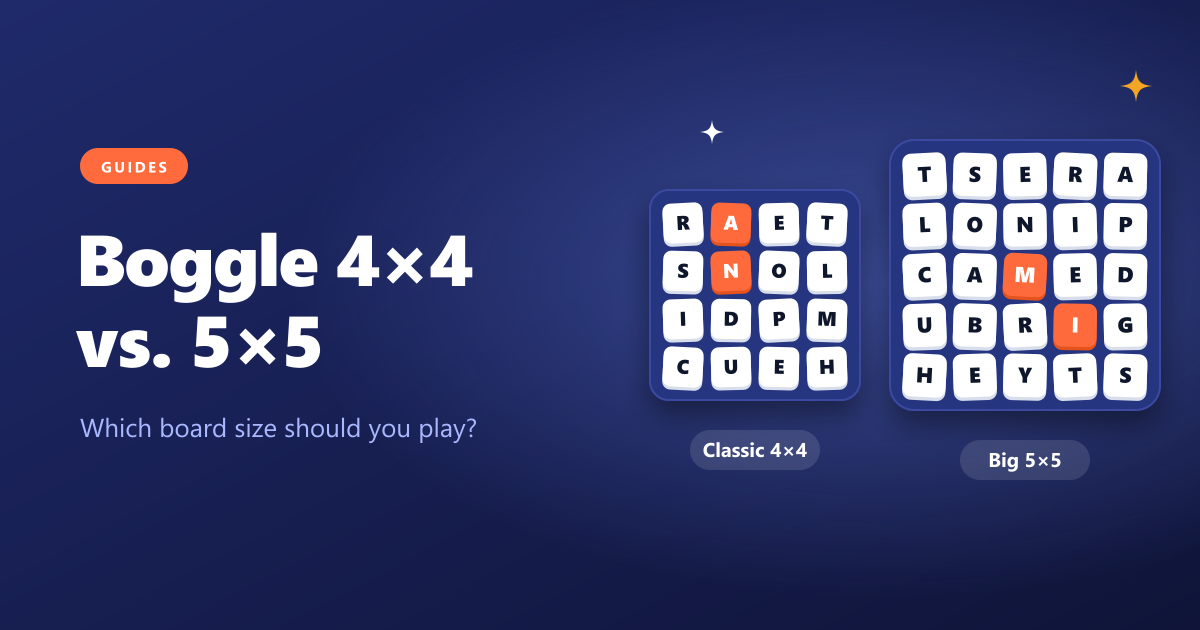
Bigger grids naturally contain more long words. Playing some rounds on a 5×5 board trains you to look for longer paths, because three-letter words usually don’t count there.
That habit carries over when you return to the smaller board, where you’ll start noticing long words that you would previously have missed.
Common Mistakes When Hunting Long Words
Even experienced players fall into a few traps when chasing long words. Watch out for these:
- Ignoring easy words: Short words can add useful points while you search for longer ones. score.
- Getting stuck on one possibility:If a word's path isn't clear, move on and return to it later.
- Forgetting word extensions: Always confirm that its letters connect in the right order without reusing a tile.
- Assuming a word is possible: Always confirm that its letters connect in the right order without reusing a tile.
- Repeating the same scanning pattern: Explore different parts of the grid instead of looking at the same area repeatedly.
How to Practise Finding Longer Words
The most useful practice happens after a round, when you can review the words you missed. Pay particular attention to six-, seven-, and eight-letter words, then trace each one on the board to see how its path works.
You can use the Boggle Solverto explore possible words on a letter grid. Reviewing its results can help you recognize useful letter patterns and understand how longer words connect across the board.
Try focusing on one strategy during each practice session. For example, spend one round looking for common endings and another building on shorter words. This makes it easier to identify which techniques help you most.
Put These Boggle Strategies into Practice
The best way to improve is to combine pattern recognition with regular play. Start by finding words you recognize, then scan for useful prefixes, endings, and longer paths as the round continues.
When you're ready to practise, play Boggle game online, and try applying one or two of these techniques in your next round. Afterward, review the words you missed and use them to guide your next practice session.
Final Thoughts
Finding long words in Boggle is a skill you can learn. Start from endings, build on the words you’ve already found, look for prefixes, compound words and letter clusters, and review what you missed.
With a little regular practice, six- and seven-letter finds will start appearing in your rounds, and the occasional 11-point word will feel within reach.