Everyone has played a round of Boggle where the board looks like a jumble of random letters, while the person next to you writes word after word. It’s easy to assume they simply know more words. In reality, strong Boggle players usually have a better system for seeing the words that are already there.
This guide covers 12 practical tips, grouped into four areas: how you scan the board, how you build words, how you use your time, and how you practise. Each tip explains what to do, why it works and how to try it in your next round. Pick two or three to focus on first, and you’ll notice the difference within a few games.
Start With How You Scan the Board
Most missed words aren’t difficult words. They’re words your eyes never landed on. Before you think about vocabulary or strategy, it’s worth improving how you look at the grid, because a better scanning habit helps with every word you find afterwards.
The three tips below change where your attention goes during a round. They feel slow at first, but they quickly become automatic.
1. Work in small sections
When you try to take in all 16 letters at once, your eyes tend to jump between the same few eye-catching letters. Large parts of the board get ignored, and you end up rediscovering words you’ve already written.
Instead, focus on one small area at a time, such as a corner or a 2×2 block. Look at how those letters connect to each other and to their immediate neighbours, write down what you find, and then move to the next section. Think of it as searching a room shelf by shelf rather than glancing around from the doorway.
A simple order works well: top-left, top-right, bottom-left, bottom-right, then the centre. The centre letters touch the most neighbours, so finishing there often reveals longer words that link two areas together.
2. Start from the strongest letters
Not every letter is equally useful. Vowels, especially E and A, appear in a huge share of English words, and consonants such as S, T, R, N and L combine with almost anything. A cluster of these letters is usually rich in words.
Difficult letters such as J, X, Z and V are the opposite. They appear in fewer words, so it rarely pays to start your search there. Use them later, once you’ve collected the easier words around them.
In practice, look for a vowel surrounded by friendly consonants and trace every short path from it before moving on. For example, an E touching R, S and T can produce words such as REST, TREES, STEER and ESTER, depending on how the other letters connect.
3. Change your viewpoint
Your brain reads letters in a familiar direction, usually left to right. That means words running upwards, backwards or diagonally are much easier to miss, even when the letters are right in front of you.
Turning the board helps break that habit. At the table, players often rotate the tray halfway through a round; online, a rotate button does the same job. The letters and their connections stay the same, but seeing them from a new angle can make a hidden word jump out.
Build Words From Patterns, Not Single Letters
Once your scanning is more organised, the next step is to stop hunting letter by letter. Experienced players recognise familiar chunks of letters and build words around them, which is much faster than testing every possible combination.
The four tips in this section show you which patterns to look for and how to turn one find into several.
4. Learn the common letter pairs
Some pairs of letters appear together constantly in English. TH, CH, SH, ST, ER, IN, AN, ON and RE are among the most useful. When two of these letters touch on the board, treat them as a single unit.
This simple shift makes searching easier. It’s far quicker to ask “what can go before or after ST?” than to consider S and T separately. Pairs also hint at word shapes: CH often starts a word, while ER often ends one.
A good exercise is to spend the first ten seconds of a round spotting every common pair on the board. Those pairs become anchor points for the rest of your search.
5. Look for endings first
Word endings are some of the easiest patterns to spot, and each one can unlock many words. The most useful endings are -ED, -ER, -ES, -EST, -ING and -LY.
The trick is to work backwards. Find the ending on the board, then look at the letters that touch its first letter. If R, E and D are connected, check what sits next to the R. You may find RED, BRED, SHRED or TIRED, depending on the surrounding letters.
An -ING ending is especially valuable. Because it already uses three letters, adding just two or three more gives you a word worth 2 or 3 points, such as SING, RING, TAKING or RAISING.
6. Add plurals and other forms
Every time you find a word, glance at the letters around its final letter. If an S touches it, you’ve probably found a second word. STONE and STONES are separate words, and both score.
The same idea works for verb forms and comparisons. PLAY can lead to PLAYS or PLAYED, while FAST may lead to FASTER or FASTEST. Players often stop at the base word and never check for these extensions, which makes them easy points.
Plurals also help in multiplayer games. Opponents often find the base word but miss the plural, so your extended version is less likely to be crossed out as a duplicate.
7. Swap a single letter
Many English words differ by just one letter. Once you’ve found BAT, look for BET, BIT, BUT, CAT, HAT or RAT nearby. Each swap uses a pattern your brain has already recognised, so the new word appears faster.
This habit is particularly useful early in a round, when you’re collecting short words. It turns a single discovery into a small family of words without needing to scan a new part of the board.
Make the Most of Every Minute
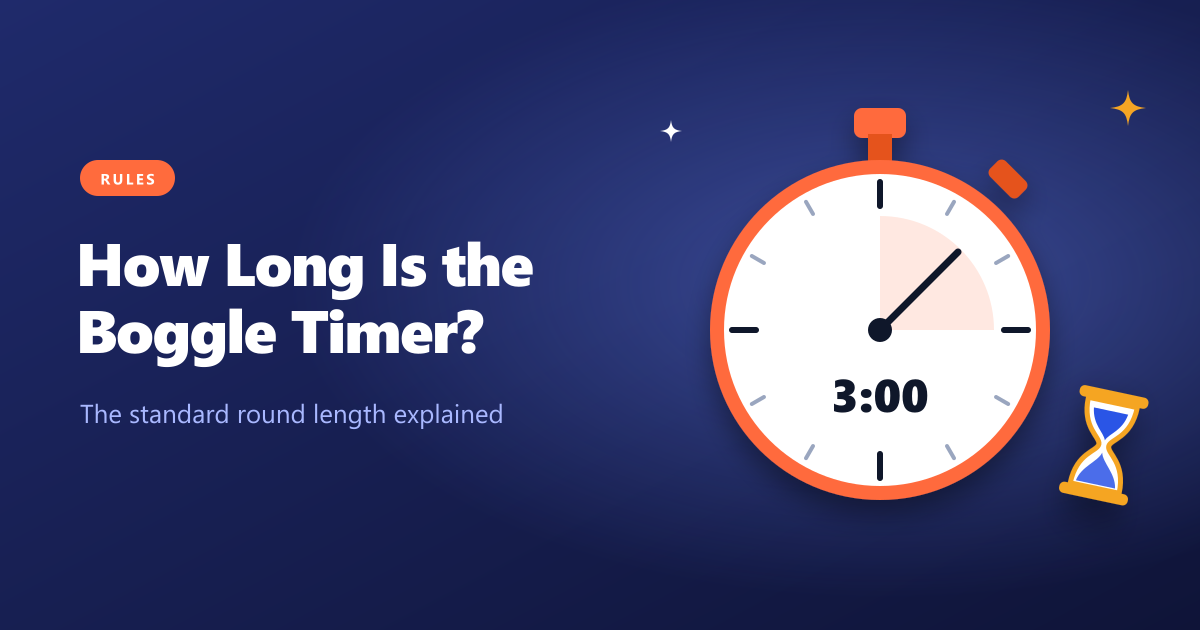
A standard round lasts only three minutes, so how you spend that time matters as much as what you know. Without a plan, it’s easy to panic early or waste the final seconds staring at one stubborn word.
The next three tips give you a simple structure for each round.
8. Collect quick wins first
Use the opening minute to pick up obvious three- and four-letter words. They’re quick to find, they build a base score and they warm up your eyes for the patterns on that particular board.
Don’t worry about finding every short word. The goal is momentum. Once you have a handful of words written down, you’ll feel more relaxed and better able to look for longer ones.
9. Save the final minute for longer words
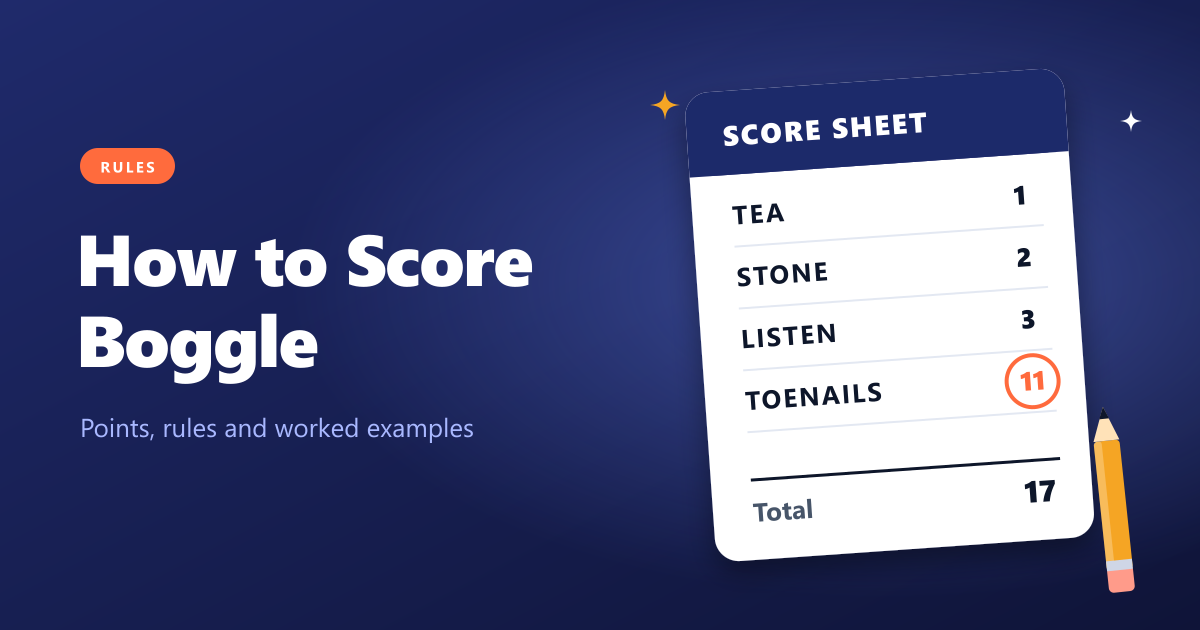
Longer words are worth far more under standard scoring. A five-letter word earns 2 points, a six-letter word 3, a seven-letter word 5 and a word of eight or more letters 11. That means one long word can outscore a whole column of short ones.
Use the last part of the round deliberately. Return to the strongest areas of the board, look for endings and prefixes, and try to extend the words you’ve already found. Even one extra five- or six-letter word makes a noticeable difference to your total.
10. Move on when you’re stuck
Every player knows the feeling of almost seeing a word but not being able to trace it. It’s tempting to keep trying, but those seconds add up quickly.
Give yourself a simple rule: if a word doesn’t come together within about ten seconds, move on. Often the word appears later, once you’ve looked at the board from a different area. In the meantime, you’ll have found several easier words.
Practise in a Way That Sticks
Tips only become habits through repetition. The good news is that effective practice doesn’t need to take long. Short, regular sessions build pattern recognition much faster than an occasional long game night.
These final two tips are the ones that make the biggest long-term difference.
11. Play short, timed rounds regularly
Playing a couple of rounds a day keeps your eyes sharp and helps the patterns from this guide become second nature. Practising against a timer matters, too, because it trains you to make quick decisions under the same pressure as a real game.
You can play Boggle game free on our site with an automatic timer, so there’s no need to set up dice or watch a sand timer. Choose a quick one-minute round when you have a spare moment, or a standard three-minute round when you want full practice.
Try focusing on one tip per session. For example, spend one day concentrating on endings and the next on plurals. Practising one skill at a time is easier than trying to apply all twelve tips at once.
12. Review the words you missed
This is the habit most players skip, and it’s the one that teaches the most. After a round, look at the words that were on the board but not on your list. You’ll quickly notice the patterns you tend to overlook, such as words running upwards or words built around a particular ending.
If you played on a physical board, you can check every word on that board with the Boggle Solver. It lists the words by length and shows the path for each one, which makes it easy to see exactly how a missed word was formed.
Common Mistakes to Avoid
Even with good habits, a few common mistakes can hold your score back. Watch out for these during your next few rounds:
- Only looking left to right. Remember that words can run in any direction, including backwards and diagonally.
- Writing words you can’t trace. Double-check that every letter touches the next and that no die is used twice.
- Ignoring short words entirely. Long words score more, but a steady supply of short words keeps your total healthy.
- Never reviewing. Without looking at missed words, it’s hard to know which patterns you keep overlooking.
Take Your Game Further
Once these habits feel natural, the next big jump in your score usually comes from longer words. They need a slightly different approach, built around prefixes, suffixes, compound words and longer letter chains.
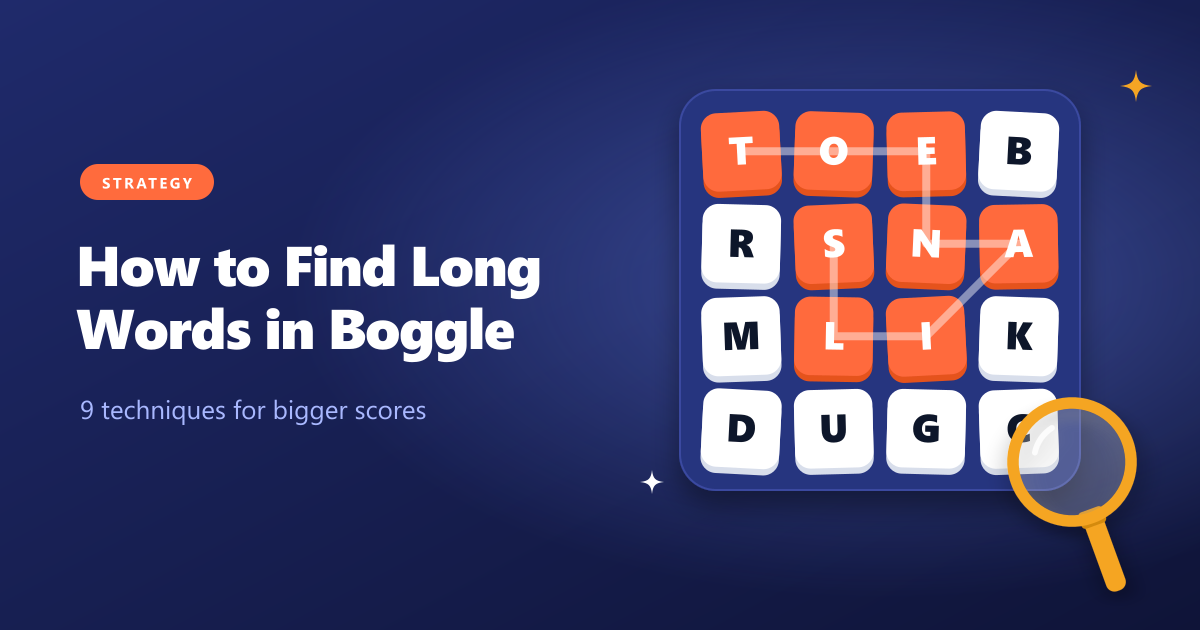
Our guide on how to find long words in Boggle covers nine techniques for spotting six-, seven- and eight-letter words, with examples you can practise straight away.
Final Thoughts
Getting better at Boggle is less about memorising rare words and more about training your eyes. Scan the board in sections, think in patterns, use your time wisely and review what you missed.
Start with one or two tips from this list, play a few rounds, and add the others as they become second nature. Within a week of regular practice, you’re likely to see your scores climb.