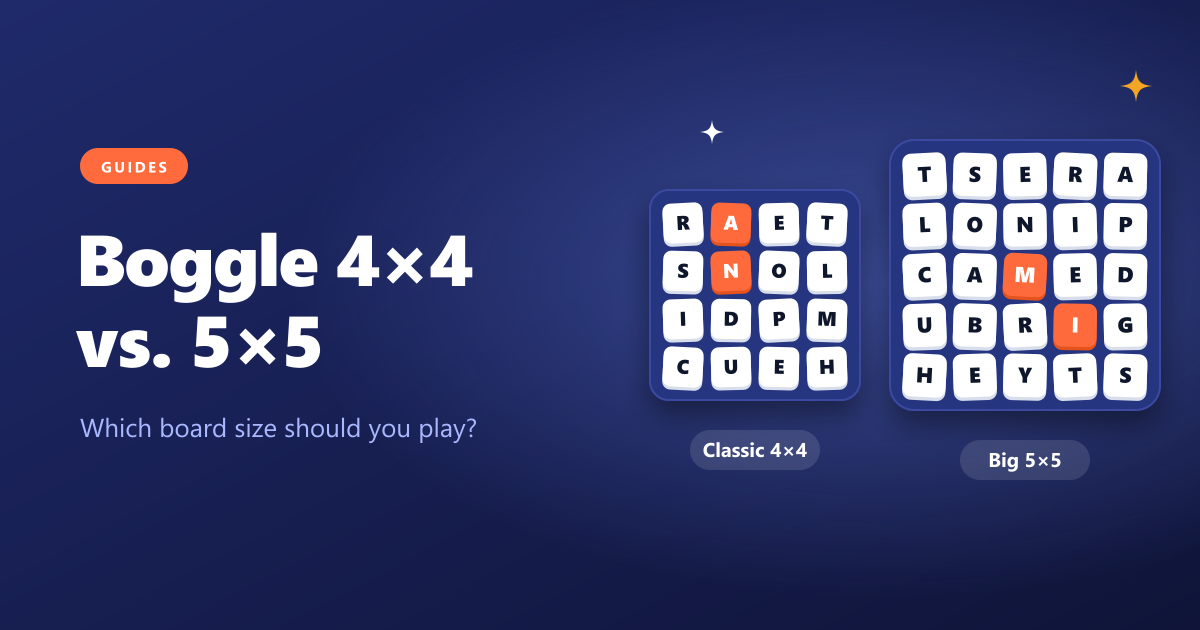
Boggle is usually played on one of two board sizes: the Classic 4×4 board with 16 letter dice, or the larger 5×5 board with 25. The core rules are almost the same, but the size of the grid changes how the game feels, how many words are available and what kind of words you look for.
This guide compares the two boards side by side, explains how each one changes your strategy and helps you decide which size suits beginners, experienced players, families and different kinds of games.
4×4 vs. 5×5 Boggle at a Glance
The table below sums up the practical differences between the two board sizes:
| Feature | Classic 4×4 | Big 5×5 |
|---|---|---|
| Letter dice | 16 | 25 |
| Shortest valid word | 3 letters | 4 letters |
| Typical words on a board* | About 90–180 | About 170–330 |
| Points table | Standard | Standard (from 4 letters) |
| Feel | Fast and focused | Open, with more to explore |
| Best for | Beginners and quick rounds | Long words and experienced players |
*Typical counts on boards rolled with the standard dice, using our word list.
The Classic 4×4 Board
The 4×4 board is the version most people know. With only 16 letters, it’s easy to take in the whole grid, and three-letter words count, so every player can start scoring from the first seconds of a round.
The compact grid also means fewer possible connections. Each letter touches at most eight others, and the corner and edge letters touch fewer. That keeps the number of words manageable and makes careful scanning very effective.
These qualities make the 4×4 board ideal for beginners, children and quick games. It’s also the usual choice for competitive rounds, where the smaller grid rewards speed and attention to detail.
The Big 5×5 Board
The 5×5 board adds nine extra letters. More letters mean many more connections, so the board usually hides far more words, including longer ones that are hard to form on a smaller grid.
To balance this, three-letter words normally don’t count. Players focus on words of four letters or more, which shifts the game towards longer, higher-scoring finds and away from quick short words.
The bigger board can feel overwhelming at first, simply because there’s so much to look at. Once you’re used to it, though, it offers more variety, more long words and plenty of room for creative searching.
The Key Differences
Beyond the number of dice, a few differences shape how each board plays. These are the ones that will affect your strategy and your scores the most.
Minimum word length
The jump from three to four letters is the biggest rule change. Many quick finds on a 4×4 board, such as TEA, CAT or RUN, simply don’t count on a 5×5 board.
This changes the opening of a round. On 4×4, you can build a base score with short words; on 5×5, you need to look for four-letter words and their extensions straight away.
Number of words
A larger grid creates many more possible paths. Even with the higher minimum length, a 5×5 board typically contains about twice as many valid words as a 4×4 board.
In practice, no one finds every word on a 5×5 board in a single round. Success comes from finding the most valuable ones, rather than trying to collect everything.
Strategy
On 4×4, success often comes from speed and collecting plenty of short and medium words. On 5×5, it pays to look for endings, prefixes and compound words, because longer words are both more common and more valuable.
A useful habit on the bigger board is to work through it in sections, such as the four corners and the centre. Without a plan, it’s easy to keep returning to the same eye-catching letters.
Time
Three minutes is standard for the 4×4 board. With a 5×5 board, some groups keep the same timer for an intense round, while others add a little extra time to explore the bigger grid. Agree on the timer before you start.
Scores
Because the 5×5 board holds more words and more long words, scores are usually higher than on the 4×4 board. If you play both sizes, compare your results within the same size rather than across them.
Which Board Should You Choose?
Both boards are fun, so the best choice depends on who’s playing and what kind of round you want.
- Choose 4×4 if you’re new to Boggle, playing with children or want quick, energetic rounds.
- Choose 5×5 if you already play regularly and want more words and longer finds.
- Choose 4×4 for competitive play, where speed and accuracy on a compact grid decide the winner.
- Switch between them to train different skills: speed on 4×4 and long-word spotting on 5×5.
Try Both Board Sizes
The easiest way to decide is to try a few rounds on each. You can generate a new 4×4 or 5×5 board with our Boggle Generator, then play it, share it or show it on a screen for a group game.
Already played a round on a physical board? You can enter the board in the Boggle Solver to see every valid word, whichever size you used. Comparing the results from both sizes is a good way to see just how much more a 5×5 board can hold.
Final Thoughts
The Classic 4×4 board is quick, focused and perfect for beginners, while the Big 5×5 board offers more letters, more words and more room for long finds.
Many players enjoy both, using the smaller board for speed and the larger one for a bigger challenge. Try each a few times and you’ll quickly discover which one suits your style.