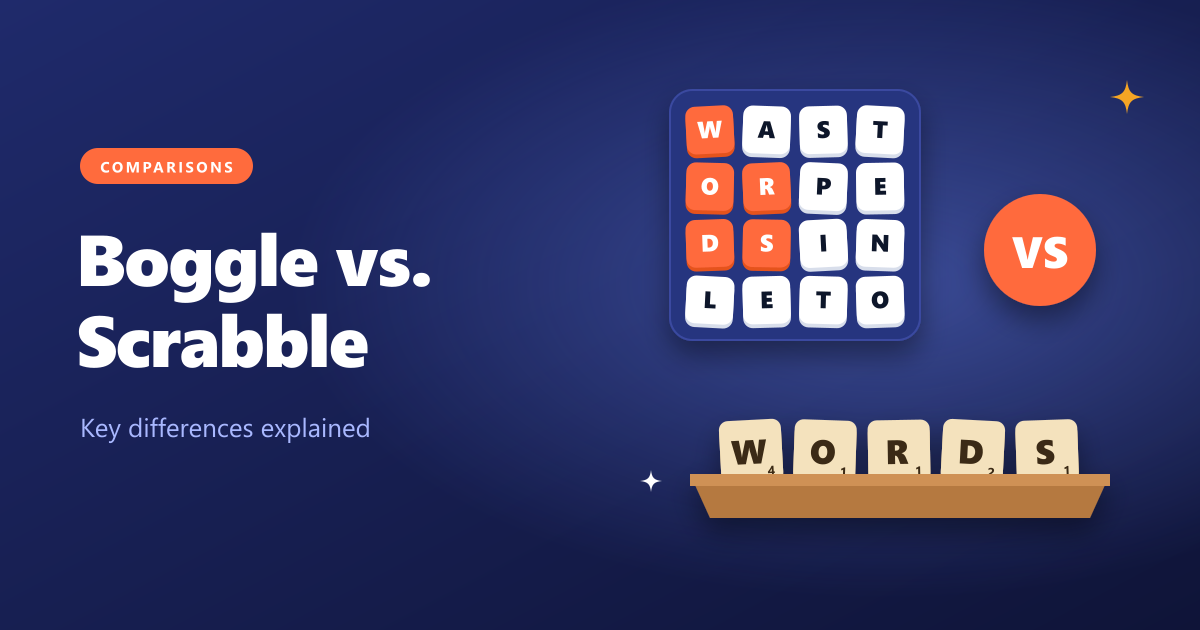
Boggle and Wordle are both word puzzles, but they ask you to do opposite things. In Wordle, you work out a single hidden word using as few guesses as possible. In Boggle, you try to find as many words as you can in a grid of letters before the timer runs out.
If you enjoy one, there’s a good chance you’ll like the other. This comparison explains how each puzzle works, five key differences, which one is harder, and how to choose the right word game for the time you have.
Boggle vs. Wordle: Quick Comparison
Here’s a short summary of how the two puzzles compare before looking at each one in more detail:
| Feature | Boggle | Wordle |
|---|---|---|
| Goal | Find as many words as possible | Guess one hidden word |
| Letters | A grid of 16 or 25 letter dice | Your own five-letter guesses |
| Time limit | Usually three minutes per round | None, just six guesses |
| How often | Unlimited rounds | One puzzle per day |
| Main skill | Spotting patterns quickly | Logic and letter elimination |
| Result | A points score | Solved in a number of guesses, or not |
| Mood | Fast and energetic | Calm and thoughtful |
What Is Boggle? A Puzzle With Many Answers
Boggle is a timed word search on a grid of lettered dice, usually 4×4. Players find words by linking letters that touch horizontally, vertically or diagonally, using each die only once per word.
Instead of one correct answer, a Boggle board hides dozens or even hundreds of words. Longer words earn more points, so the challenge is to find as many valuable words as possible before time runs out. When the round ends, a new board brings a completely fresh puzzle.
What Is Wordle?
Wordle is a daily guessing puzzle. You have six attempts to find a hidden five-letter word, and each guess must be a real word. There’s one puzzle each day, and everyone gets the same answer, which is a big part of why it became such a popular shared habit.
How Wordle’s colour clues work
After each guess, the tiles change colour to show how close you were:
- Green means the letter is in the word and in the right position.
- Yellow means the letter is in the word but in a different position.
- Grey means the letter isn’t in the word at all.
You combine these clues to rule out letters and test new positions until you find the answer. An optional hard mode raises the challenge by requiring you to use every clue you’ve already revealed in your next guess.
Boggle vs. Wordle: 5 Key Differences
Although both games are built around letters, they exercise different parts of your brain. These five differences are the ones players notice first when switching between them.
1. One answer vs. many answers
Wordle has exactly one correct word, and every guess is a step towards it. Boggle has no single answer. You’re collecting as many valid words as you can, and two players can have very different lists from the same board.
2. Untimed vs. against the clock
Wordle has no clock, so you can pause, think and come back later. Boggle is played against a timer, which adds urgency and rewards quick decisions. Your mood often decides which one feels more appealing.
3. One puzzle a day vs. unlimited rounds
Wordle’s single daily puzzle turns it into a short ritual: once it’s solved, you wait until tomorrow. Boggle has no such limit, so you can play one round or twenty, depending on how much time you have.
4. Pass-or-fail vs. a points score
A Wordle result is simple: you solve the puzzle in a certain number of guesses, or you don’t. Boggle gives you a score, which makes it easy to track gradual progress and set targets, such as beating yesterday’s total.
5. How you play with others
Wordle is usually played alone, with results shared afterwards as a small grid of coloured squares. Boggle can be played solo, but it was designed for groups, with everyone racing the same board at the same time.
Is Boggle Harder Than Wordle?
They’re hard in different ways, so the answer depends on your strengths. Wordle is a contained puzzle with clear feedback, and most regular players solve it within six guesses. Its difficulty lies in logic and avoiding wasted guesses.
Boggle is open-ended. You can always find more words, so there’s never a moment when the puzzle is fully “solved.” Its difficulty comes from speed, pattern recognition and the pressure of the clock.
Many players find Wordle easier to complete but Boggle harder to master. If you enjoy steady, methodical thinking, Wordle may feel more comfortable; if you thrive under time pressure, Boggle will likely suit you better.
Skills Each Game Develops
Both puzzles are good exercise for your brain, but they train slightly different skills:
- Wordle builds logical reasoning, letter-frequency knowledge and patience.
- Boggle builds visual scanning, speed, pattern recognition and vocabulary.
- Both strengthen spelling and familiarity with common English letter combinations.
Can Wordle Players Get Good at Boggle Quickly?
Yes, often faster than complete beginners. Wordle players develop a strong sense of which letters appear together and where they tend to sit in a word, such as common endings like -ER and -ED or opening pairs like ST and CH.
That knowledge transfers directly to Boggle, where spotting familiar letter clusters is the key to finding words quickly. The main adjustment is speed: Wordle players are used to thinking slowly and carefully, while Boggle rewards fast, instinctive searching.
Daily Word Puzzles: Wordle and Daily Boggle
If the shared daily puzzle is what you love about Wordle, Boggle offers a similar ritual. With the Daily Boggle challenge, everyone gets the same letter board each day, so you can compare scores with friends who played the same puzzle.
The difference is what happens next. Wordle ends once you’ve solved it, while a daily Boggle board can be replayed to beat your own score, and there are always more boards if you want to keep going.
Which Word Game Should You Play?
Your choice depends on what you want from a word game and how much time you have:
- A calm morning puzzle: Wordle, with no clock and a single satisfying answer.
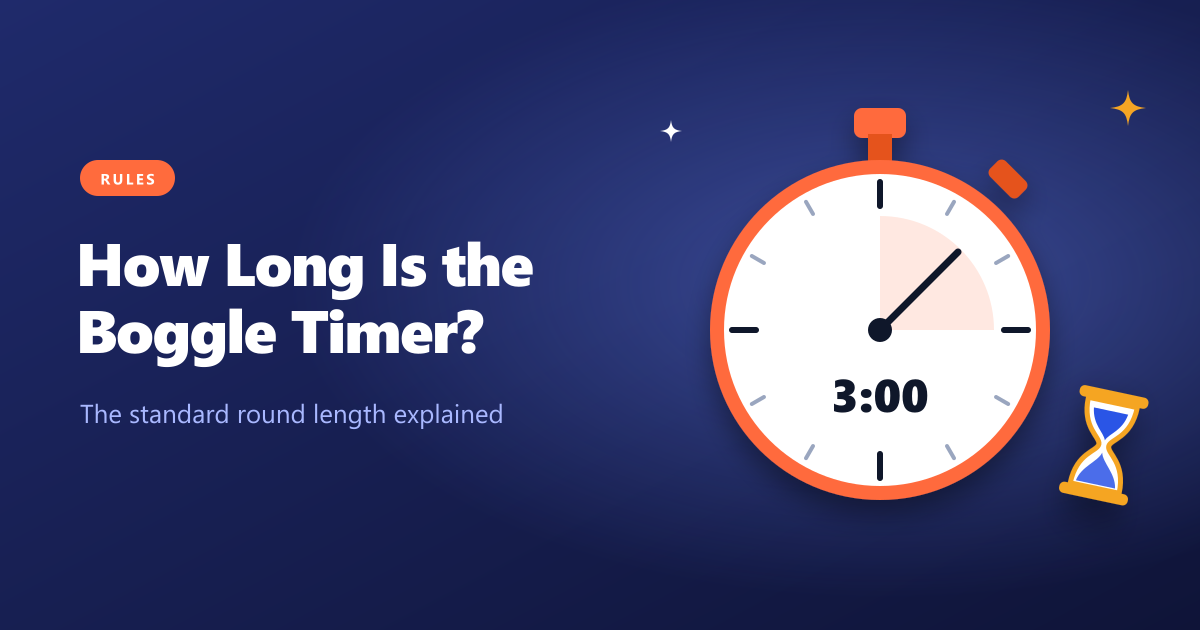
- A quick burst of energy: Boggle, with a three-minute race against the timer.
- More than one puzzle a day: Boggle, which offers unlimited fresh boards.
- A game for a group: Boggle, where everyone plays the same board at once.
- A mix of both: Wordle for logic and Boggle for speed, played on the same day.
How Boggle Compares With Scrabble
Wordle is a modern daily puzzle, but many players also compare Boggle with a classic board game. Our article on Boggle vs. Scrabble looks at how Boggle’s fast, shared rounds compare with a slower, turn-based game built on tile values and strategy.
Boggle vs. Wordle: The Verdict
Wordle and Boggle make a natural pair. One asks you to solve a single word with careful logic, and the other asks you to find as many words as possible before time runs out.
If you enjoy Wordle and fancy a faster, more open-ended challenge, play Boggle free online and see how many words you can find in your first round. You may find that the two games complement each other perfectly.