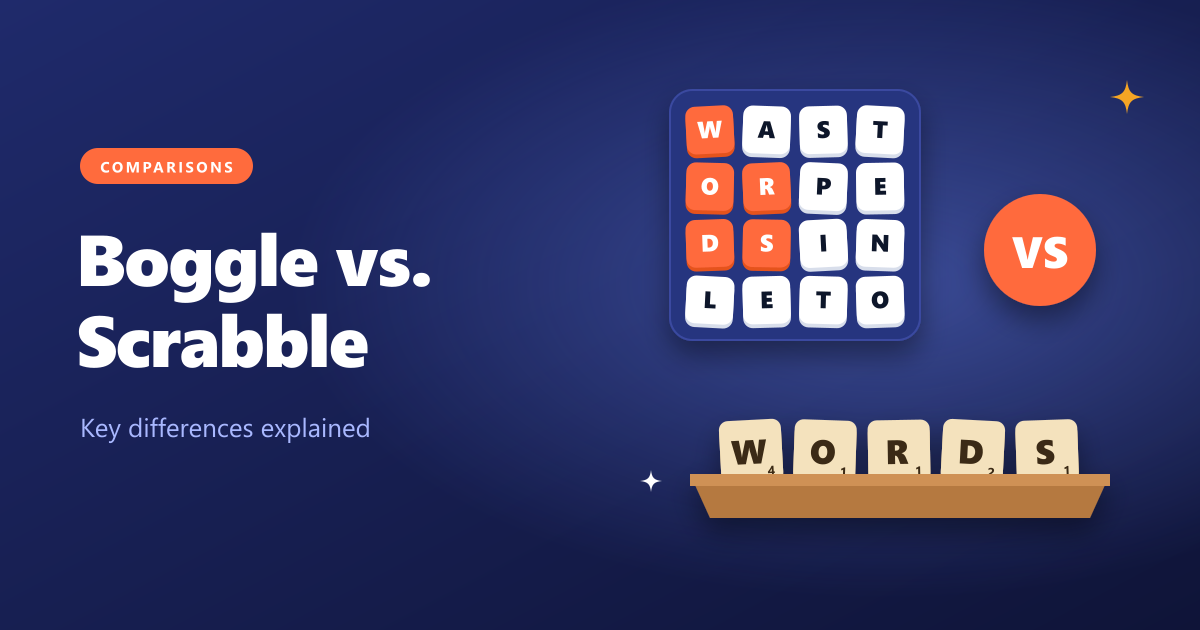
Boggle and Scrabble are two of the most famous word games ever made, and both reward a strong vocabulary. That’s where the similarities start to fade. Boggle is a fast race where everyone searches the same grid of letters at once, while Scrabble is a slower, turn-based game of building words on a board with your own tiles.
If you’re choosing between them for a game night, or wondering why some people love one and avoid the other, this comparison will help. It looks at how each game plays, six key differences, which one is easier to learn and which one suits your group best.
Boggle vs. Scrabble: Quick Comparison
If you only have a moment, this side-by-side table covers the main differences between the two games:
| Feature | Boggle | Scrabble |
|---|---|---|
| Letters | One shared grid of letter dice | A private rack of seven tiles per player |
| Turns | Everyone plays at the same time | Players take turns |
| Typical length | Rounds of about three minutes | Often an hour or more |
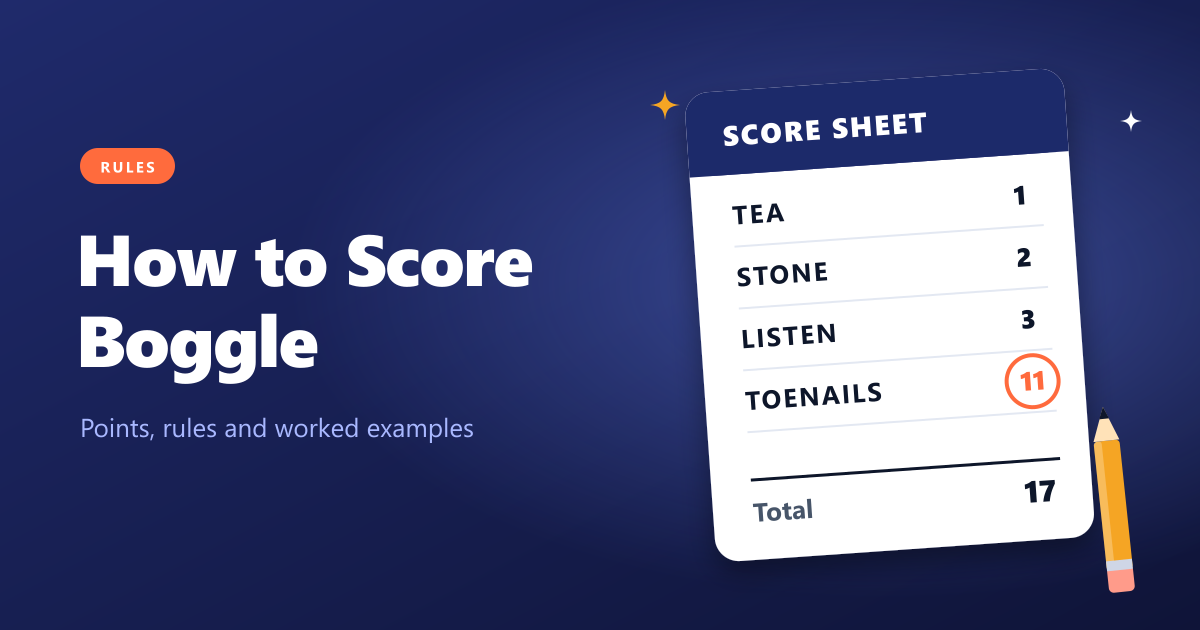
| Scoring | Based on word length | Based on letter values and bonus squares |
| Main skill | Speed and pattern spotting | Planning and board strategy |
| Group size | Works with many players | Usually two to four players |
| Atmosphere | Fast and lively | Calm and tactical |
How a Round of Boggle Plays
Boggle is a timed word search played on a grid of lettered dice, usually 4×4. When the timer starts, every player hunts for words by linking letters that touch horizontally, vertically or diagonally, writing down as many as they can before time runs out.
Because all players work on the same letters at once, nobody waits for a turn, and a full round is over in minutes. If you’ve never tried it, you can play a Boggle game in your browser to get a feel for its pace before comparing it with Scrabble.
What Is Scrabble?
Scrabble is a board game in which each player draws seven letter tiles from a bag and keeps them hidden on a rack. On your turn, you place tiles on a 15×15 board to create a word that connects with words already played.
Every tile has a point value, with common letters such as E worth less than rare letters such as Z or Q. Coloured bonus squares can double or triple a letter or an entire word, and playing all seven tiles in one turn earns a 50-point bonus. You can also choose to swap tiles instead of playing, at the cost of a turn.
The game continues, turn by turn, until the tiles run out. With thoughtful players, that usually takes far longer than a few rounds of Boggle.
Boggle vs. Scrabble: 6 Key Differences
Both games are about making words, but the way they ask you to do it couldn’t be more different. These six differences explain why each game feels the way it does.
1. Simultaneous play vs. taking turns
In Boggle, everyone plays at the same time, so every player is active for the whole round. There’s no downtime and no waiting while someone else thinks.
Scrabble is strictly turn-based. That gives each player time to plan, but it also means sitting out while others consider their moves, which can feel slow with indecisive players.
2. Shared letters vs. a private tile rack
Boggle players all see the same letters, so the challenge is spotting what’s there before the timer ends. In Scrabble, you see only your own seven tiles plus the board, and you don’t know what your opponents are holding.
That hidden information gives Scrabble a tactical, almost card-game feel, while Boggle is completely open.
3. Length-based scoring vs. letter values
Boggle points depend only on how long a word is, so longer words are always worth more. A rare letter earns no extra reward.
Scrabble works the other way round. A short word with a high-value letter placed on a triple-word square can outscore a much longer word placed elsewhere, so where you play matters as much as what you play.
4. Pattern spotting vs. board strategy
Boggle is about perception: noticing endings, plurals and letter combinations quickly. The best players train their eyes to see words fast.
Scrabble is closer to a strategy game. Strong players manage the tiles they keep, open or block bonus squares and set up big turns several moves ahead.
5. Game length and pace
A Boggle round lasts about three minutes, and a whole game of several rounds can fit into a coffee break. Scrabble usually takes considerably longer, often an hour or more, which makes it better suited to a relaxed evening.
6. Group size
Boggle handles large groups easily because adding players doesn’t make a round any longer. All you need is a pencil and paper for each person.
Scrabble is designed for two to four players. Beyond that, the waits between turns become long, and the game loses some of its momentum.
How Luck Affects Each Game
Every word game involves some luck, but it shows up differently in these two. In Boggle, the board is random, yet everyone faces the same letters. A difficult board is difficult for all players, so the result still comes down to skill.
In Scrabble, the tiles you draw are private and random. A rack full of vowels, or a run without useful letters, can make a turn genuinely hard no matter how good you are. Experienced players reduce this by managing their rack carefully and exchanging tiles when needed.
Is Boggle Easier Than Scrabble?
For most new players, Boggle is easier to learn. The rules can be explained in a minute: find words in touching letters before the timer runs out. There are no tile values, bonus squares or placement rules to remember.
Scrabble takes longer to learn well. Beginners can play quickly, but understanding tile values, bonus squares and rack management takes practice.
That said, “easier to learn” doesn’t mean “easier to master.” Top Boggle players need remarkable speed and pattern recognition, while top Scrabble players rely on deep strategy and extensive word knowledge. Both games have plenty of room to improve.
Where Boggle and Scrabble Overlap
Despite their differences, the two games share several qualities that make them classics:
- Both reward a broad vocabulary and accurate spelling.
- Both build words from a limited set of letters.
- Both can be played casually at home or competitively.
- Both introduce players to new words, which makes them popular in classrooms.
- Both are traditionally played face to face around a table.
Which Should You Play: Boggle or Scrabble?
There’s no single winner. The better choice depends on who’s playing, how much time you have and the kind of experience you want. These common situations make the decision easier:
- A big family gathering: choose Boggle, because everyone can play at once.
- A quiet evening for two: choose Scrabble for a longer, more tactical contest.
- Only ten minutes to spare: choose Boggle, since a few rounds fit easily.
- Players who love planning: choose Scrabble, where strategy pays off over many turns.
- Players who love speed: choose Boggle, where quick eyes beat careful deliberation.
How Boggle Compares With Other Word Games
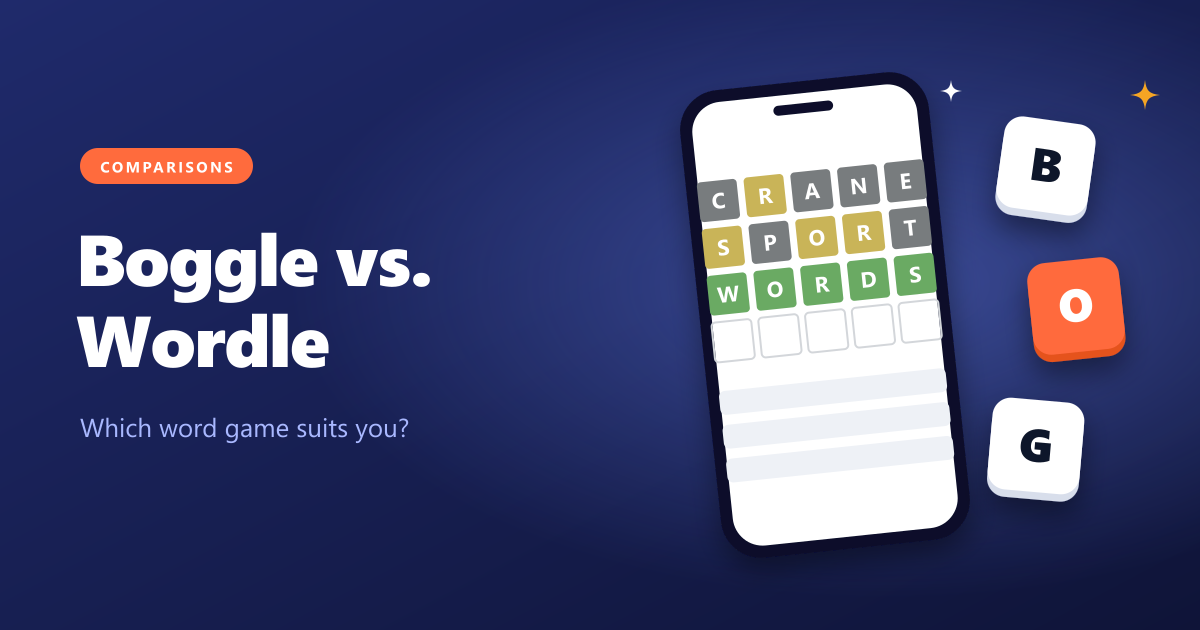
Scrabble isn’t the only popular game people compare with Boggle. Daily guessing puzzles have become hugely popular, and they test very different skills from either board game. Our comparison of Boggle vs. Wordle explains how deducing a single hidden word differs from racing to find dozens.
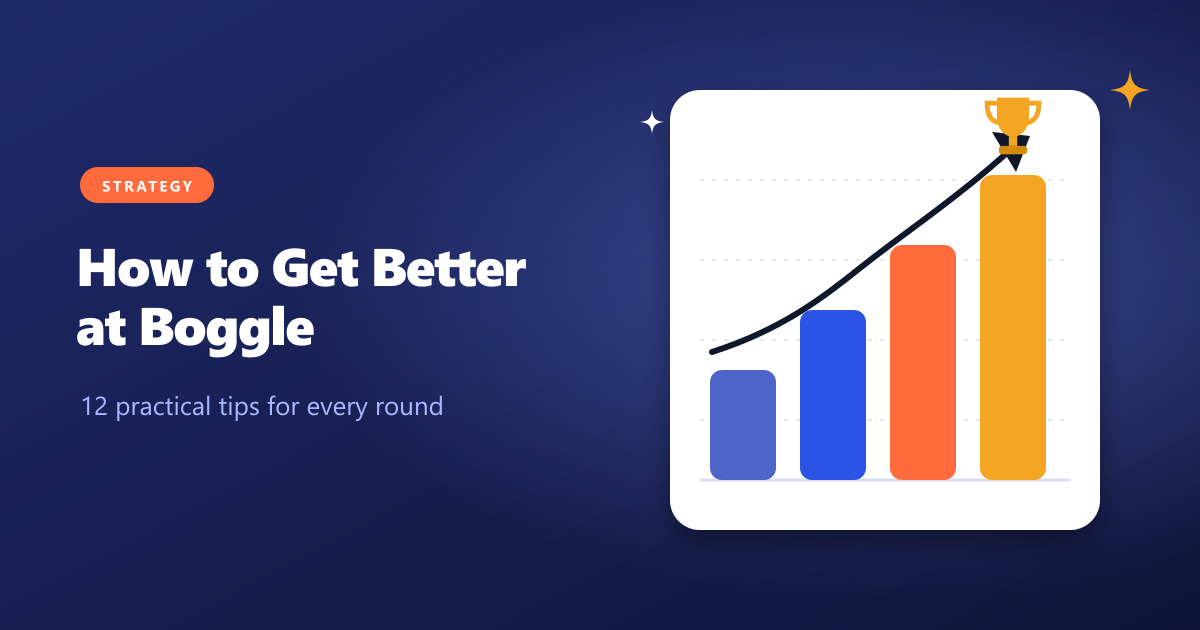
If this comparison has convinced you to give Boggle a proper try, our guide on how to get better at Boggle shares practical habits for scanning the board and finding more words every round.
Boggle vs. Scrabble: The Verdict
Boggle and Scrabble both celebrate words, but in very different ways. Boggle is a quick, shared race against the clock that suits groups and busy schedules. Scrabble is a patient battle of tactics, tile management and board position that rewards careful planning.
If you value speed and inclusiveness, start with Boggle. If you enjoy strategy and don’t mind a longer game, reach for Scrabble. And if you love words, there’s every reason to keep both on the shelf.